CppVerify
CppVerify is a verifier for C++ that checks your code against the properties you write in the program itself — and reports whether those properties always hold, or shows you when they can fail.
Formal verification lets you treat correctness as an engineering artifact: you state what should be true, and the tool either proves it or gives you a precise reason it does not. CppVerify brings that discipline to everyday C++ without a separate language or annotation dialect.
Install
Each release has
archives for Linux x86_64 and macOS arm64: unpack one and run
bin/cpp-verify --version. The macOS binaries are not notarized; if macOS
refuses to open one downloaded with a browser, remove the quarantine mark with
xattr -dr com.apple.quarantine on the unpacked directory. To build from
source:
brew install cmake ninja git
git clone --recurse-submodules https://github.com/SwayamInSync/cpp-verify.git
cd cpp-verify
./setup.sh
→ build/bin/cpp-verify, build/bin/clang++, build/bin/clangd, build/bin/clang-format
sudo apt install cmake ninja-build build-essential git
git clone --recurse-submodules https://github.com/SwayamInSync/cpp-verify.git
cd cpp-verify
./setup.sh
→ build/bin/cpp-verify, build/bin/clang++, build/bin/clangd, build/bin/clang-format
Install CMake, Ninja,
Git, and Python 3,
plus Visual Studio Build Tools (C++ workload). Run the commands from an x64 Developer
PowerShell for VS 2022 (or an x64 Native Tools prompt) so that CMake finds the compiler, or
pass -Generator "Visual Studio 17 2022" to setup.ps1.
git clone --recurse-submodules https://github.com/SwayamInSync/cpp-verify.git
cd cpp-verify
.\setup.ps1
→ build\bin\cpp-verify.exe, build\bin\clang++.exe, build\bin\clangd.exe, build\bin\clang-format.exe
Manual build (from repository root; same flags as setup.sh)
On macOS, also pass -DCLANG_USE_XCSELECT=ON, as setup.sh does, so that the
built clang++ finds the SDK without SDKROOT.
cmake -S llvm -B build -G Ninja \
  -DCMAKE_BUILD_TYPE=Release \
  -DLLVM_ENABLE_PROJECTS="clang;clang-tools-extra" \
  -DLLVM_TARGETS_TO_BUILD=Native \
  -DCPPVERIFY_VENDOR_Z3=ON \
  -DCPPVERIFY_PREFER_SYSTEM_Z3=OFF
ninja -C build clang cpp-verify clangd clang-format
cmake -S llvm -B build -G Ninja `
  -DCMAKE_BUILD_TYPE=Release `
  -DLLVM_ENABLE_PROJECTS="clang;clang-tools-extra" `
  -DLLVM_TARGETS_TO_BUILD=Native `
  -DCPPVERIFY_VENDOR_Z3=ON `
  -DCPPVERIFY_PREFER_SYSTEM_Z3=OFF
cmake --build build --target clang cpp-verify clangd clang-format --parallel
cmake -S llvm -B build `
  -G "Visual Studio 17 2022" -A x64 `
  -DLLVM_ENABLE_PROJECTS="clang;clang-tools-extra" `
  -DLLVM_TARGETS_TO_BUILD=Native `
  -DCPPVERIFY_VENDOR_Z3=ON `
  -DCPPVERIFY_PREFER_SYSTEM_Z3=OFF
cmake --build build --config Release --target clang cpp-verify clangd clang-format --parallel
Quick start
int abs(int x)
  cppverify::pre(x >= -2147483647)   // every int except INT_MIN, whose negation overflows
  cppverify::post(cppverify::result >= 0)
{
  return x < 0 ? -x : x;
}
./build/bin/cpp-verify abs.cpp
./build/bin/clang++ -std=c++17 -fverify-contracts -c abs.cpp -o abs.o
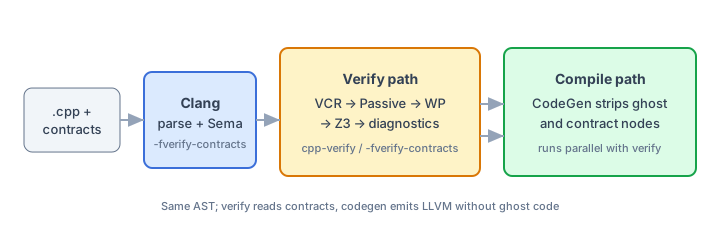
Use -fverify-contracts on clang++ so the constructs (cppverify::pre,
cppverify::post, …) are recognized. cpp-verify adds that flag automatically.
Every construct is written qualified; the examples below use the alias that a
file declares with namespace cv = cppverify;.
Verified scalar lifetimes
CppVerify also tracks initialized local scalar new/delete lifetimes:
namespace cv = cppverify;

int roundtrip(int value) cv::post(cv::result == value) {
  int *p = new int;
  *p = value;
  int observed = *p;
  delete p;
  return observed;
}
Use-after-delete, double-delete, overlapping live allocations, and reads before initialization are proof failures. See Dynamic storage for the bounded local and inferred fresh-owned factory subset.
Address-preserving scalar references
Contracted executable free functions may use scalar T& and const T&
parameters:
namespace cv = cppverify;

void increment(int& value)
  cv::pre(value < 2147483647)
  cv::modifies(value)
  cv::post(value == cv::old(value) + 1)
{
  ++value;
}
Reference values lower to heap loads, writes lower to stores, and cppverify::old reads
the entry heap. The bounded scalar slice supports direct forwarding, direct
*p bindings, fields and elements of local objects and of parameter buffers,
ordinary initialized scalar local actuals, and chained local reference aliases.
Conditional bindings, temporaries, reference returns, and non-scalar referents
remain fail-closed. See
Pointers.
Backends and modular calls
cpp-verify --backend=portfolio --cvc5-path=/usr/bin/cvc5 critical.cpp
cpp-verify --backend=bmc --unroll=3 loops.cpp
cpp-verify --lean-fallback=proof hard_goal.cpp
cpp-verify --dump-ir=3,4 debug.cpp
cpp-verify --lower-only --obligation-out=goals.cpv debug.cpp
cpp-verify --obligation-in=goals.cpv --backend=z3
See Chapter 17 — Backends, modular calls, and debugging for Z3, bounded analysis,
editable Lean certification, and chained calls like f(g(x)).
Learn more
Foundations (Part I) and using CppVerify on C++ (Part II).
Contract syntax and flags.
C++ headers in clang/lib/Verify (Doxygen).
LLVM ULEB128, UTF-8 validation, and binary search.