Chapter 4 — Hoare logic
Hoare logic (Tony Hoare, 1969) is the standard way to attach logical formulas to programs. The central object is the Hoare triple.
The Hoare triple
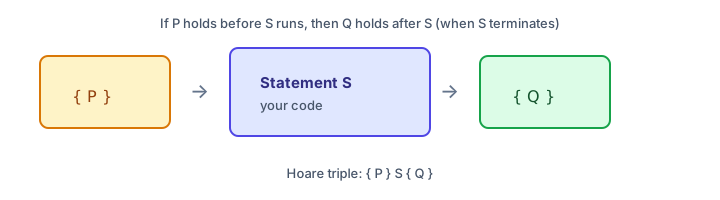
Written \(\{P\}\,S\,\{Q\}\):
P— precondition (what we assume beforeSruns)S— a statement or sequenceQ— postcondition (what we guarantee afterSfinishes, if it terminates)
Partial correctness: we do not promise termination yet; we promise if S terminates and P held at the start, then Q holds at the end.
Assignment rule (intuition)
After x = e, any fact that mentions x must be updated. The classic weakest precondition
of assignment x := e with postcondition Q is:
Q[x := e] // substitute e for x in Q
Example: after x = y + 1, to know x > 0, it suffices to know y + 1 > 0 beforehand.
Sequence rule
If \(\{P\}S_1\{R\}\) and \(\{R\}S_2\{Q\}\), then \(\{P\}S_1; S_2\{Q\}\).
The intermediate formula R links the two steps — often the post of the first equals the pre of the second.
Conditional rule
To prove \(\{P\}\textbf{if }(c)\,S_1\textbf{ else }S_2\{Q\}\):
Prove \(\{P \land c\}S_1\{Q\}\)
Prove \(\{P \land \lnot c\}S_2\{Q\}\)
This matches how you reason about if/else on paper.
Modular function calls
For a call to f with contract requires P_f, ensures Q_f:
Caller must prove the precondition
P_fat the call site.Caller may assume
Q_fafter the call (with return value wired tocppverify::resultin CppVerify).
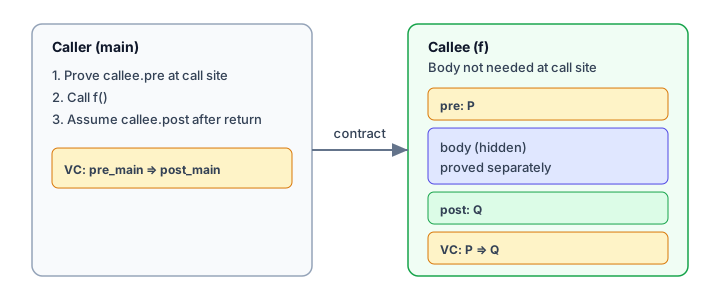
The callee’s source body is not needed at the call site — only its contract. That is how large programs scale.