Chapter 2 — The limits of testing
Testing is the default way we gain confidence in software. It is indispensable — and incomplete for proving absence of bugs.
What testing does well
Finds witnesses to failure quickly (a concrete input that reproduces a crash).
Validates integration, performance, and human-visible behavior.
Cheap to run on every commit in CI.
What testing cannot guarantee
Consider int abs(int x) that should return a non-negative value. Tests might check:
assert(abs(0) == 0);
assert(abs(-3) == 3);
assert(abs(5) == 5);
There are infinitely many int values. No finite test suite exercises all of them.
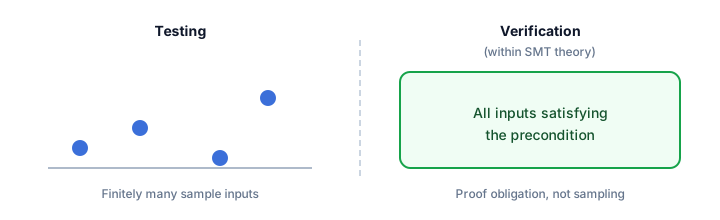
Even with billions of random tests, absence of observed failure is not proof of absence of bugs. The industry phrase is “testing shows presence, not absence, of errors.”
Path explosion in control flow
int f(int a, int b, int c) {
  int x = 0;
  if (a > 0) x++;
  if (b > 0) x++;
  if (c > 0) x++;
  return x;
}
Three if statements yield \(2^3 = 8\) paths. Add loops and pointers: path count explodes.
Test coverage metrics (line, branch) under-approximate which logical combinations were exercised.
Regression vs proof
A test encodes one scenario: “when I call f(1,2,3), I expect 3.” A proof encodes a
general claim: “for all inputs satisfying the precondition, the postcondition holds.”
When someone later edits f, tests might still pass while a new input breaks an unstated assumption.
A verified contract fails until the proof obligation is discharged again.
When testing remains essential
Verification models a subset of reality (integer semantics, memory model, no concurrency yet). Tests still catch:
Spec wrong for the real world (“we proved the wrong thing”).
Compiler/backend bugs outside the verifier model.
Environment issues (I/O, configuration).
Use tests and verification together: tests for reality checks; verification for logical implications inside the modeled language.