Chapter 5 — Invariants and loops
Loops repeat. Testing loops samples a few iteration counts; verification needs a single formula true on every iteration — a loop invariant.
The three obligations
For loop condition cond, invariant I, and body B:
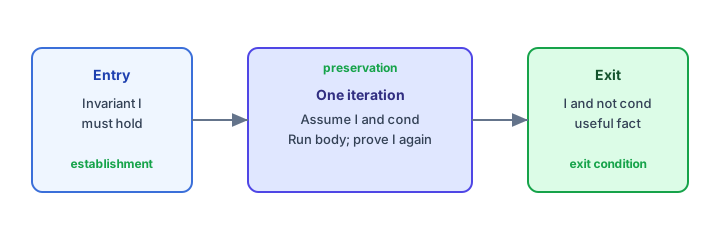
Establishment —
Iholds when we first reach the loop.Preservation — if
Iandcondhold, running one iteration ofByieldsIagain.Exit — when the loop stops, we have
Iandnot cond. That is what we use to prove goals after the loop.
Example: ascending index
int i = 0;
while (i < n) {
  // body uses i
  i++;
}
A typical invariant: 0 <= i && i <= n.
Establishment:
i == 0gives0 <= iandi <= nifn >= 0.Preservation: if
i < n, afteri++stilli <= nandiincreased.Exit:
i >= nandi < nfalse ⇒i == n.
Finding invariants
Invariants are the creative part of loop proofs. Strategies:
Define a relation between variables (
s == sum of first i elements).Bounds on indices (
0 <= i <= n).Copy of the post — sometimes the postcondition, weakened, is invariant.
Too weak an invariant fails preservation; too strong fails establishment.
Termination measures
Invariants alone give partial correctness. To prove the loop terminates, use a variant (termination measure) that:
Is bounded below (often
>= 0)Strictly decreases each iteration while the loop runs
Example: cppverify::decreases(n - i) in a loop where i increases toward n.
CppVerify will check both invariant preservation and measure decrease (Part II).